
This project highlights the work of José Bringas, a creative technologist and designer who developed The Microscopic, a public video mapping installation exhibited at the Art Gallery of Ontario in March 2025. The project showcased a real-time generative AI system that transformed human gestures into live visuals, blending art, technology, and interaction. By exploring the possibilities of computer vision and AI-driven animation, José pushed the boundaries of how design can embody vision, enhance functionality, build brand identity, consider environment, and support wellbeing.
1. Vision
The vision behind The Microscopic was to explore co-creation between humans and machines. While staying aligned with the AGO’s artistic identity, José aimed to excite and attract visitors through an installation that allowed the audience to become active participants. Using Computer Vision, a real-time software for live installations, the system layered diffusion-model AI imagery over pre-authored particle animations. Gesture-based interaction, primarily hand motions, acted as a brush or tool, letting visitors shape the evolving visuals.
2. Functionality
Functionality centered on making abstract technology accessible to a diverse audience. Translating hand gestures into real-time transformations introduced usability challenges: the interface was unconventional, with no keyboard or mouse. For many, the experience required a learning curve to understand what actions influenced the visuals.
José addressed this by encouraging playful exploration, children adapted quickly, unafraid to experiment with posture and motion. Testing and refinement relied on iterative practice, research, and professional feedback from computer science and design experts. This process underscored that intuitive interaction and audience onboarding are crucial in interactive media design.
3. Brand
For José, The Microscopic was also a brand-defining moment. By publicly presenting such an experimental system at a major cultural institution, he established himself as a creative technologist unafraid to push boundaries. The project enhanced his professional brand, signaling innovation and leadership in new media art.
Through visibility at the AGO, his work reached a broader network of collaborators and audiences, reinforcing his identity as a designer who bridges art, technology, and real-world applications.
4. Environment
The installation also reflected considerations of environment and production sustainability. By leveraging digital projection and real-time rendering, The Microscopic minimized physical material use compared to traditional print or static exhibitions. This reduced waste and aligned with sustainable practices increasingly prioritized in cultural institutions.
5. Health and Wellbeing
Clarity and accessibility played a central role in visitor wellbeing. By standardizing layouts, using recognizable visual cues, and reducing visual clutter, José helped audiences feel comfortable navigating the experience. The gesture-based system encouraged movement, creativity, and mental engagement, transforming the exhibition into a playful, low-stress environment.
6. Key Success Performance Indicators
Successful demonstration of gesture-driven AI visuals in a public setting
Strong engagement and interaction across a diverse audience
Elevated professional brand identity for José as a creative technologist
Sustainable use of digital media to reduce physical production
Clear, accessible, and enjoyable visitor experience
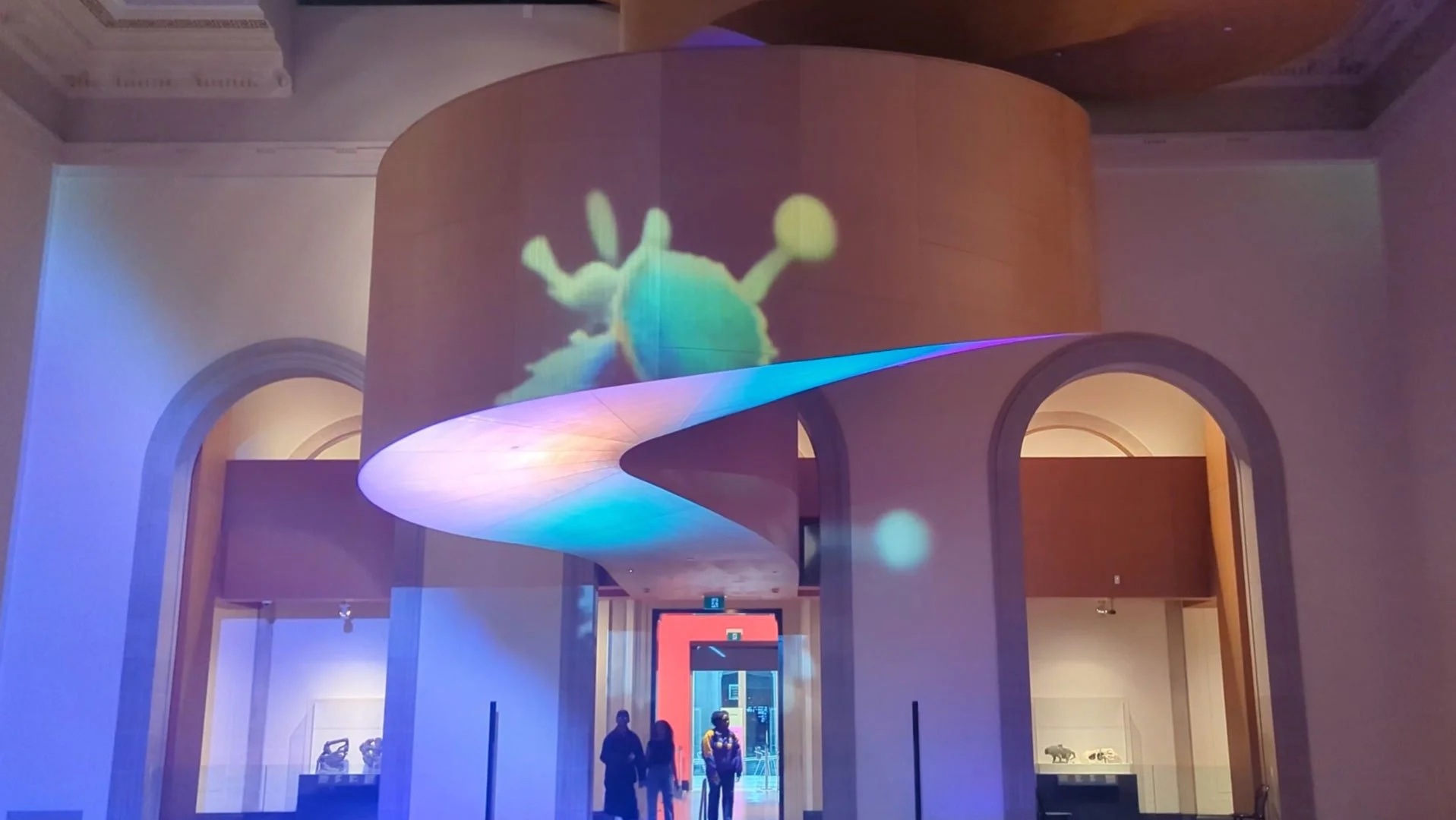
Image provided by Jose Bringas
